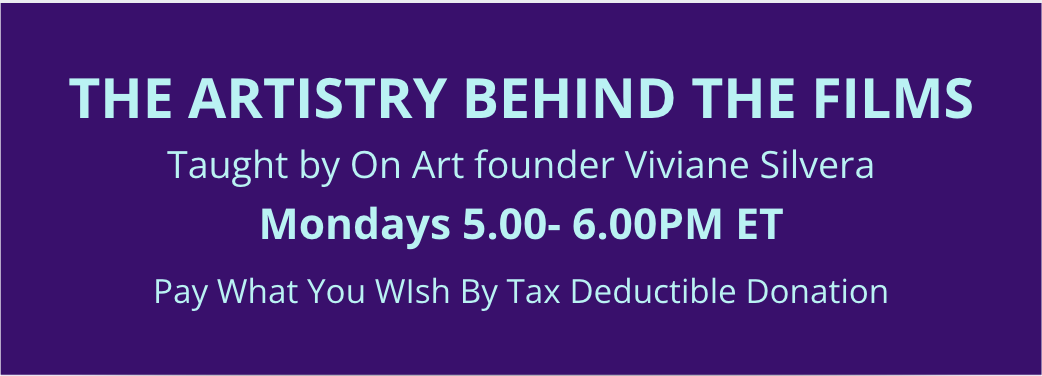
You’ll be taken to On Art’s page at the Center for Independent Documentary (CID), our nonprofit fiscal sponsor. All contributions go directly to making our films. U.S. donations are tax-deductible as allowed by law.
Donate to Watch: Webinar Archive
Pay-What-You-Wish. Tax-deductible via CID. Funds support Viviane’s next hand-painted film, The Memory Loophole.
Donate to Watch
Suggested donation $35–$75 per class; any amount is welcome.
How it works: Donate → reply to your receipt with the titles you want → we send Vimeo links + passwords within 24 hours.
Cinematography & Storytelling
Hamnet
Dirty Dancing — Camera choreography that makes romance move.
Past Lives — Quiet frames, aching time, crossing paths.
Maestro — Conductor’s ego through sound and close-ups.
In the Mood for Love — Color and corridor as desire.
Anatomy of a Fall — Neutral palettes that raise doubt.
Oppenheimer (Parts I & II) — IMAX scale versus intimate moral weight.
Barbie — Plastic fantasia with meaningful production design.
The Power of the Dog — Landscapes frame repression and menace.
La La Land — Color blocking and musical movement.
Tár — Stillness and sound as power plays.
Nora Ephron Part 1 (When Harry Met Sally) — Banter, blocking, and New York warmth.
Nora Ephron Part 2 (Silkwood, Heartburn, Sleepless in Seattle) — Tone from kitchen tables to skyline kisses.
Scorsese: Raging Bull — Editing as conscience; black-and-white brutality.
Scorsese: The Age of Innocence — Close-ups as corsets; etiquette as prison.
Tootsie — Costume and performance revealing identity.
White Tiger — Gritty frames of ambition and class.
King Richard — Family blocking and coach’s gaze.
CODA — Silence, sound, and belonging.
Boyhood — Real time, real growth: visual continuity.
Temple Grandin — Visualizing thought: sound and design.
Where Film and Painting Meet
Light It Like Rembrandt (overview: Goya, Bacon, Botticelli, Rembrandt) — How masters’ light guides movies.
Bridgerton (Velázquez, Van Dyck, and more) — Portrait palettes in modern romance.
Caravaggio’s The Calling of Saint Matthew & Rousseau’s The Snake Charmer in Apocalypse Now — Classic canvases inside modern cinema.
Scorsese & Caravaggio — Sacred light in profane worlds.
Spielberg & Norman Rockwell — American nostalgia with moral bite.
Frida Kahlo in Julie Taymor’s Frida — Living paintings, fearless color.
Gerhard Richter in Never Look Away — Blurs that sharpen memory.
Hidden in Plain Sight (Bacon, Goya, Turner, others) — Fine-art quotes you’ve been missing.
Magical Realism
Amélie — Playful color to re-enchant Paris.
Life of Pi — Dreamlike seas, survival myth.
Forrest Gump — American memory as fable.
On Sculpture
Rodin: Father of Modern Sculpture — Form, shadow, and movement in bronze.
Camille Claudel: “Please Tell Them What Happened to Me” — Genius sculpted and sidelined.
Memory Films & Series
Ordinary People — Suburban spaces hold suppressed grief.
Eternal Sunshine of the Spotless Mind — Memory maps in color and cut.
Never Look Away — A painter’s gaze reshapes truth.
In Treatment — Minimal frames, maximal psychology.
The English Patient — Desert light as memory’s glow.
Life of Pi — Mythic color for survival stories.
Schindler’s List — Monochrome witness; a red memory.
Inside Out — Emotion design that teaches feeling.
Stories We Tell — Family archive as narrative puzzle.
The Artistry Behind Limited Series
The Residence — Visual whodunit inside the White House.
Ripley — Black-and-white tension and moral shade.
Curb Your Enthusiasm — Improvised chaos with invisible design.
Extraordinary Attorney Woo — Color as neurodivergent perspective.
The Bureau — Plain frames, deep suspense.
Bridgerton — Opulence as character and conflict.
Succession — Zooms, glass, and power distance.
The Marvelous Mrs. Maisel — Candy colors and rat-a-tat rhythm.
The Gilded Age — Gowns, staircases, social combat.
The Queen’s Gambit — Chess boards as psychology.
Unorthodox — Spare images, identity in transition.
The Crown — Ceremonial framing, human cracks.
My Brilliant Friend — Neapolitan light and female bonds.
Normal People — Close-up intimacy without sentimentality.
The Bear — Kitchen chaos with precision blocking.
Dickinson — Period meets pop; playful anachronism.
Call My Agent! — Office staging that breathes comedy.
Schitt’s Creek — Small-town palettes, big-heart arcs.
Queen Charlotte — Royal romance, painterly light.
On Photography
Annie Leibovitz — Staging intimacy at scale.
Richard Avedon — Minimal backgrounds, maximum truth.
Robert Farber — Soft focus, sensual color.
Jewish Themes in Film & TV
A Real Pain — Grief, humor, and heritage in motion.
The Making of Schindler’s List — Craft choices behind witness.
The Ripple Effects of Schindler’s List — How one film shaped memory.
Golda — War-room faces, cigarettes, decisions.
The Spy — Retro palettes, real dangers.
The Marvelous Mrs. Maisel — Jewish family rhythm as music.
The Beauty Queen of Jerusalem — Ladino echoes, saturated history.
Fleishman Is in Trouble — NYC frames midlife unraveling.
Non-Fiction / Documentary
In Restless Dreams — Studio as memory: Paul Simon.
Mountain Queen — Altitude, grit, and identity.
The Last Movie Stars — Archive reimagined for modern eyes.
The Rescue — Claustrophobia, courage, and water.
The Painter and the Thief — Gaze, forgiveness, power.
Searching for Sugar Man — Myth, music, and discovery.
Three Identical Strangers — Twins, ethics, and framing truth.
My Octopus Teacher — Underwater intimacy without words.
Navalny — Urgency in handheld witness.
Free Solo — Vertigo by design.
All That Breathes — Delhi’s air, tender focus.
Fantastic Fungi — Time-lapse awe and hidden worlds.
Prefer an at-a-glance list? Email us for a curated suggestion based on your interests.
Email for Access