A new film from Emmy Award–winning director Viviane Silvera
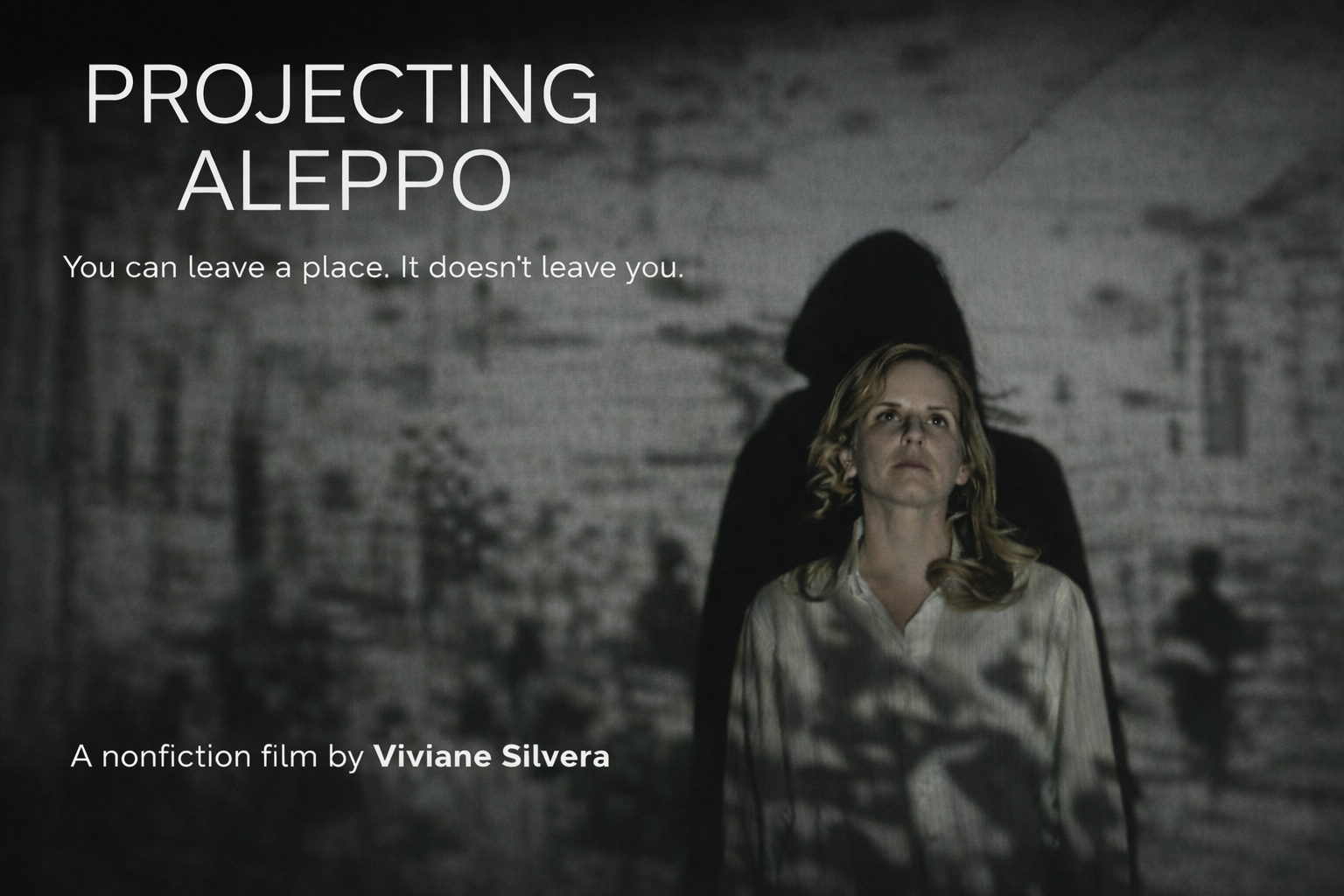
A film that uses projection, painting, and archive to explore Sephardic memory, oral testimony, and the legacy of the 15th-century Corfu Bible.
PROJECTING ALEPPO
PROJECTING ALEPPO is a nonfiction film about inheritance, exile, and the responsibility of carrying what survives. Through one family's story, it seeks to recover an overlooked chapter of Jewish history: the displacement of nearly a million Jews from the Middle East and North Africa.
My father survived by looking forward. I have spent much of my life looking backward, trying to understand the past in order to move forward. For years, we approached memory from opposite directions. Now, for the first time, we are making a film together about the world he left behind.
My father was born in Aleppo (Halab), Syria, in 1931. At sixteen, he watched from his balcony as the Silvera Synagogue, built by his father, burned during the 1947 riots that followed the United Nations vote to partition Palestine. In the years that followed, Jewish life narrowed under surveillance and restriction. At eighteen, he fled. His family would not be reunited for ten years.
For my father, survival meant building a new life, not dwelling on the one he had lost. For me, an artist and filmmaker whose work explores memory, it has meant trying to understand the past, including the parts of my family's history that were rarely spoken about.
His story belongs to a much larger history, one that remains unfamiliar to many American Jews. In the United States, where roughly two-thirds of Jews identify as Ashkenazi, our collective understanding of Jewish exile has been shaped largely by the experiences of European Jews: pogroms, the Holocaust, and immigration to America. Yet in Israel, roughly half the Jewish population identifies as Sephardic or Mizrahi, with roots in the Middle East, North Africa, and beyond.
These are two very different inheritances of Jewish history.
For centuries, Jewish communities flourished across the Middle East. In Baghdad, Jews once made up roughly a third of the population. In Aleppo, Jewish life stretched back more than two thousand years. But during the upheavals of the twentieth century, hundreds of thousands of Jews fled or left countries across the region, many under persecution and severe restrictions. Within a few decades, communities that had existed for generations were almost entirely gone.
A few years after my father's escape, my uncle left Syria carrying a 15th-century parchment Torah manuscript known as the Silvera Manuscript (Corfu Bible), which had survived the fires intact. In 1961, my grandfather donated it to Israel's Ben-Zvi Institute in Jerusalem as a complete gift, an act of devotion to the Jewish homeland. The manuscript was later lost.
The disappearance of this manuscript raises questions that extend beyond my family's history.
What does it mean to entrust memory to a nation? What happens when the objects that bear witness to our past disappear? How can a history be central to one part of a people, yet remain largely unknown to another?
The film unfolds inside my studio. Archival photographs of Aleppo are projected onto unfinished canvases. Satellite images of Hong Kong, where I was born but do not fully remember, glow on the wall. My father speaks of Halab in fragments. I paint between us. As we revisit the streets, the synagogue, the escape, and the lost manuscript, two very different relationships to the past begin to meet.
For decades, my father and I have carried the same history differently. He moved forward by leaving it behind. I have tried to move forward by understanding it. Now, as the generation that remembers Jewish life in the Arab world grows older, we are finally turning toward that history together.
At a moment when Jewish communities are once again negotiating questions of fear, identity, and belonging, PROJECTING ALEPPO seeks to bridge a gap in our collective memory, bringing the largely overlooked experiences of Jews from the Middle East and North Africa into a wider understanding of Jewish history.
But at its heart, the film is also about a father and daughter finding a way to understand each other through the past they have carried so differently.
It explores exile not only as rupture, but as agency: a tradition of rebuilding, of movement, and of choosing life.
Related Writing
In my essay Choosing to Remember (On Being Jewish Now, July 2025), I reflect on my father’s escape from Aleppo, my childhood in Hong Kong, and how a film about memory became a meditation on Jewish inheritance.
The piece explores my father’s escape from Aleppo, my childhood in Hong Kong, and the moment I realized that a film about memory had become something deeply Jewish.
Recent Interview
I recently spoke with Emily Frances on i24 News about memory, art, and the origins of Projecting Aleppo, as well as my previous film See Memory, now airing on PBS.